Manual tracker or spreadsheet
You design and maintain the model
- Define formulas and categories
- Clean and reconcile records
- Set and revise targets
For people who have outgrown manual tracking
Spreadsheets and trackers can organize transactions. Expense Atlas uses mathematical optimization to recommend a Personalized Budget balanced across debt, emergency savings, goals, retirement, liquidity, and everyday spending, then leaves acceptance and monitoring to you.
Manual tracker or spreadsheet
Expense Atlas
The core difference
Expense Atlas is not just a faster ledger. It recommends a balanced allocation across competing priorities, preserves hard guardrails, and still requires your review before acceptance and ongoing comparison with actual activity.
Receipt capture, imports, merchant cleanup, categorization, and supported reconciliation make gaps and corrections visible.
Bounded mathematical optimization recommends a Personalized Budget across debt, emergency savings, goals, retirement, liquidity, and everyday spending.
Acceptance saves a stable snapshot. Current overrides create the Selected Budget used to compare with actual activity.
Hard guardrails and competing priorities
Debt, emergency savings, goals, retirement, liquidity, and everyday spending often pull in different directions. Expense Atlas recommends a balanced allocation within protected floors and hard constraints, then shows the result for review.
It uses mathematical optimization to recommend a balanced allocation, but it does not solely maximize or guarantee net-worth growth.
Activity
Categorized spending patterns
Profile
Income and household inputs
Priorities
Debt, savings, and retirement goals
Control
Preferences, guardrails, and overrides
The score summarizes available budget and goal signals. Its breakdown can point to emergency-fund inputs, savings capacity, or over-budget categories that may deserve review.
It is not a credit score, a diagnosis, or proof that a household is financially healthy. Its usefulness depends on the completeness and accuracy of the inputs.
What the score can flag
The score can highlight these items in its breakdown so you can choose what to inspect next.
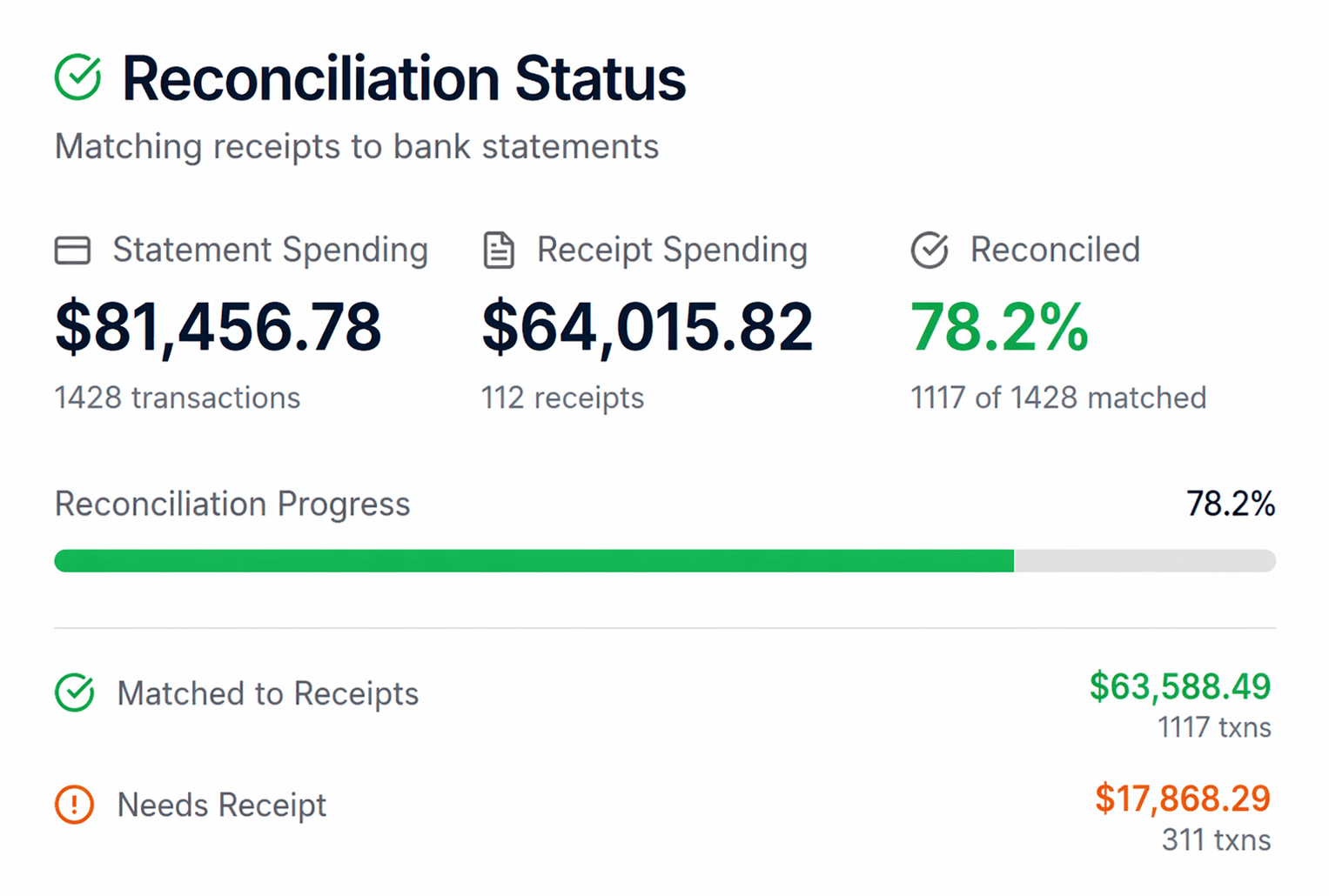
A bank description may show that money moved without showing the receipt detail behind it. Supported receipt extraction and matching can connect those records, while the status view keeps unmatched activity visible.
Matching depends on document quality and available transaction fields. Results remain reviewable and may need correction.
Expense Atlas fits people who want the detail behind their spending to inform a budget without maintaining every formula and review step themselves.